
IC443 The Jellyfish Nebula
IC443 The Jellyfish Nebula
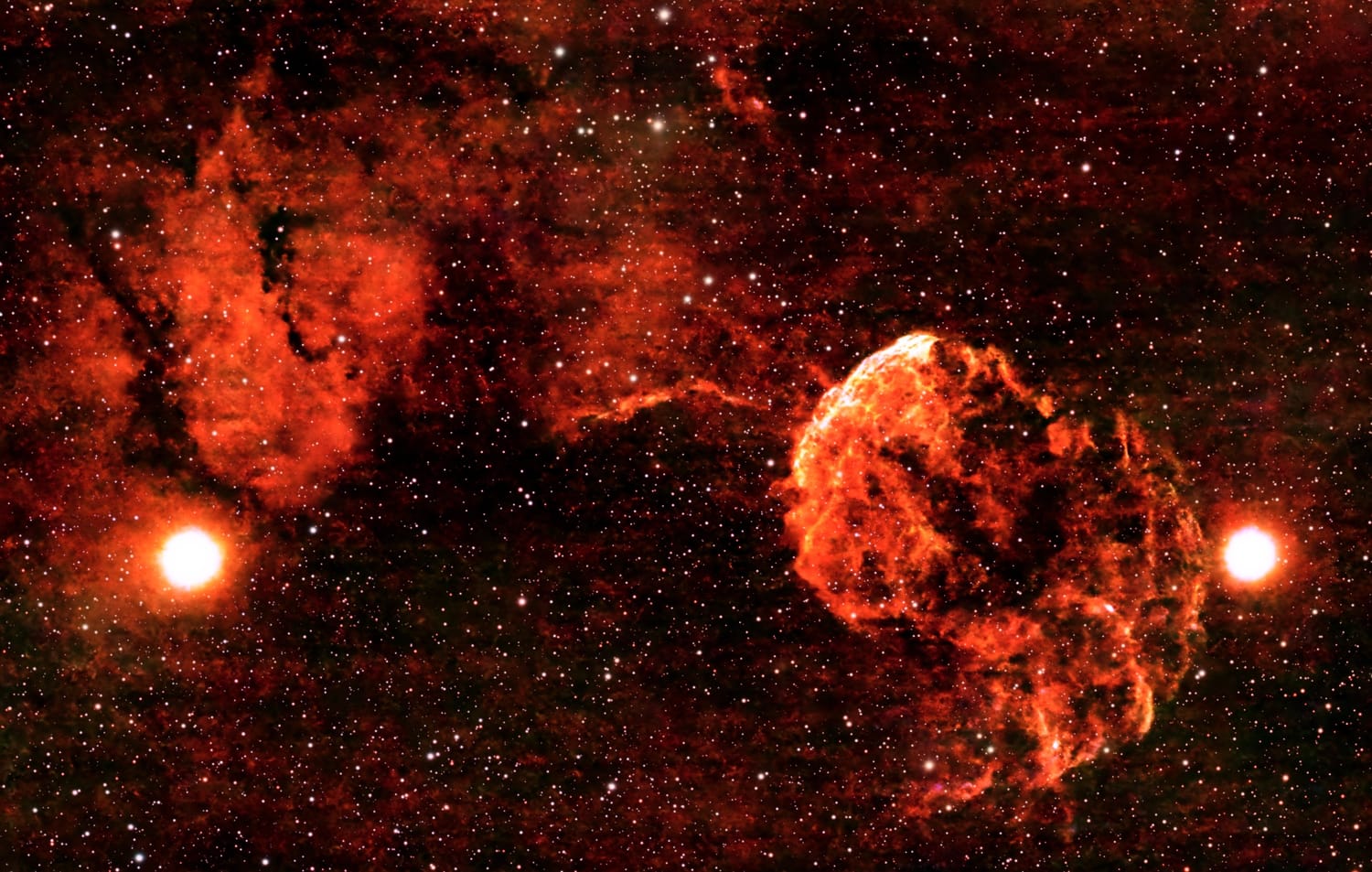
IC 443: The Jellyfish Nebula
IC 443 — better known by astronomers as the Jellyfish Nebula or Sharpless 248 (Sh2-248) — is one of the most studied examples of a supernova remnant in our Milky Way Galaxy. This glowing cosmic structure lies about 5,000 light-years from Earth in the constellation Gemini, and its name comes from the way its filaments resemble the flowing tentacles of a jellyfish.
In this article we’ll explore what IC 443 is, how it formed, what makes it scientifically interesting, and where you can learn more. The reading level is aimed at around 16 years old, with clear explanations and references to follow up on your own.
What Is a Supernova Remnant?
Before we talk specifically about IC 443, it helps to understand what a supernova remnant (SNR) is.
A supernova is the explosive death of a massive star — one much larger than our Sun. When such a star runs out of fuel, its core collapses under gravity, and the outer layers explode outward in a colossal blast. This explosion spreads shock waves and high-energy particles into space and leaves behind glowing clouds of gas and dust called supernova remnants. IC 443 is one of these. The shock wave heats the surrounding material, making it visible across many wavelengths, from radio waves to X-rays.
How the Jellyfish Nebula Formed
IC 443 was born when a massive star exploded in our galaxy. This explosion likely happened tens of thousands of years ago — estimates vary from a few thousand to around 30,000 years — making it ancient from a human point of view but still young on cosmic timescales.
The explosion sent shock waves racing outward, sweeping up and heating the gas and dust around the star. Over time, these shock waves have created the complex, filamentary structure we see today — an expanding bubble of glowing material. The eastern and northern halves of the remnant appear different from the southern half because the shock wave has hit clouds of different densities, shaping the nebula in asymmetrical ways.
Scientists believe the collapsed core of the original star became a neutron star — an extremely dense object made mostly of neutrons. Evidence for this is the detection of a compact object near the southern edge of the remnant called CXOU J061705.3+222127, which is likely a pulsar — a rapidly spinning neutron star left over from the explosion.
Why It’s Called the “Jellyfish” Nebula
Astronomers gave the name “Jellyfish Nebula” to IC 443 because its optical and infrared appearance resembles the shape of a jellyfish drifting through space. The long, curved filaments of gas look like tentacles trailing behind a glowing head. In many telescopic images, these filaments stand out — especially when viewed using narrowband filters that isolate specific colours of light emitted by ionised gases.
The nebula’s physical size is also impressive: it spans around 70 light-years across — for comparison, our own Solar System’s outer boundary (the heliopause) is only about a fraction of a light-year across.
What Makes IC 443 Special?
1. Interaction with Molecular Clouds
One reason IC 443 attracts scientists’ attention is how it interacts with nearby molecular clouds — cold, dense regions of gas that can later form stars. As the shock wave from the supernova expands, it slams into these clouds. This creates complex shock fronts and glowing filaments that astronomers can observe in different wavelengths, especially infrared and radio. This interaction is a laboratory for understanding how supernova remnants influence nearby material in space.
2. Mixed Morphology
IC 443 is a good example of what astronomers call mixed-morphology supernova remnants. This means that, unlike some simpler spherical shells, its structure includes regions with different shapes, temperatures, and emission types, depending on how the shock wave has interacted with the surrounding environment. Some parts emit strongly in X-rays, others glow in optical and infrared light.
3. Cosmic Rays and High-Energy Physics
The nebula has also helped scientists test theories about how cosmic rays — high-energy particles that travel through space — are produced. Observations with telescopes like NASA’s Fermi Gamma-ray Space Telescope have shown features in IC 443’s gamma-ray emission that indicate protons (the nuclei of hydrogen atoms) are being accelerated to high speeds by the shock waves. This gives direct evidence that supernova remnants can make cosmic rays — a major scientific question for decades.
Studying IC 443 Across the Spectrum
Astronomers don’t just look at IC 443 with optical telescopes. It appears in:
Radio waves, showing the shape of the outer shell and its filaments.
Infrared light, revealing warm dust and interactions with molecular clouds.
X-rays, showing very hot gas and evidence of the central neutron star.
By combining observations across the electromagnetic spectrum, researchers build a more complete picture of how the remnant evolves and how it affects the space around it.
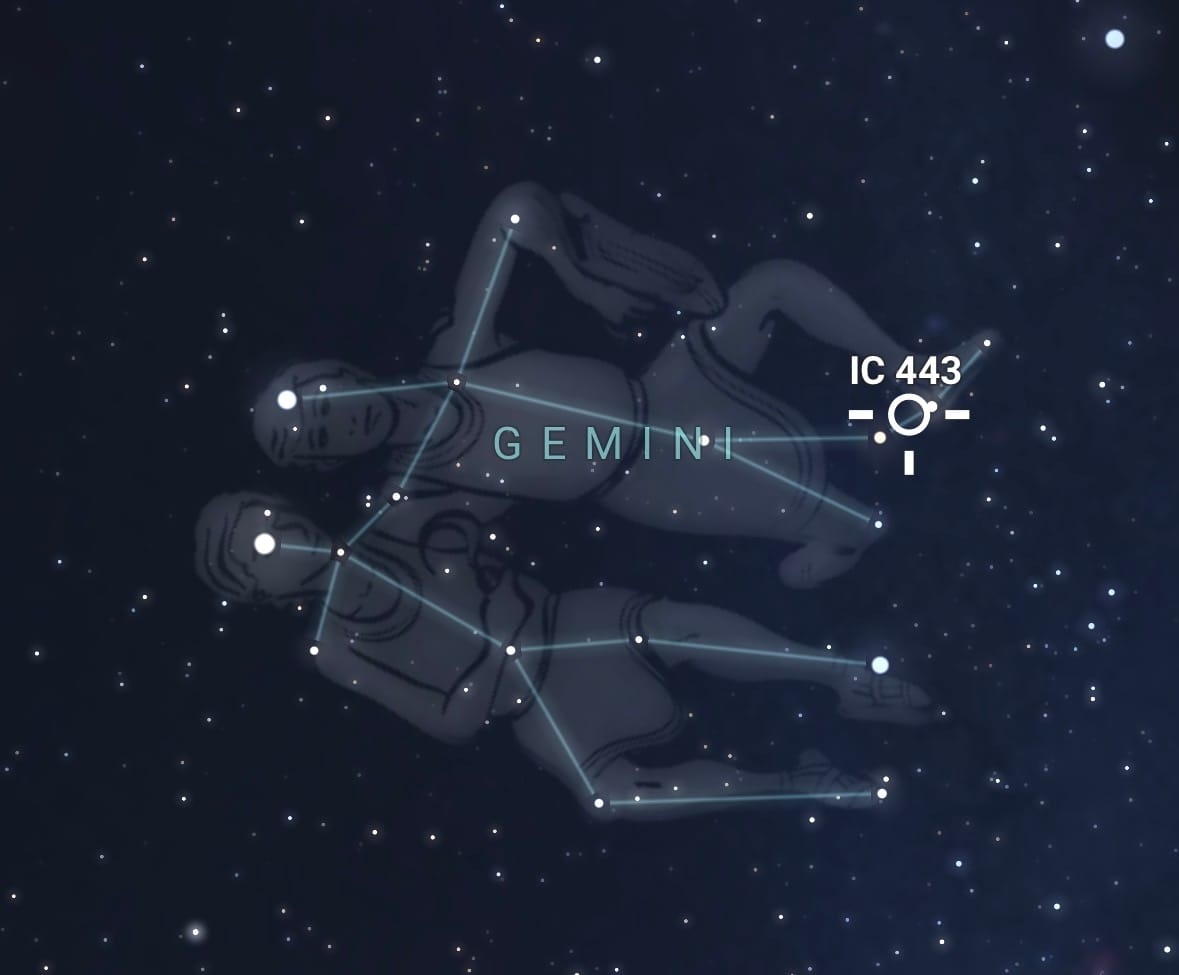
The location of IC 443 within Gemini, produced using Stellarium.
How to Observe IC 443
The Jellyfish Nebula is visible with mid-to-large amateur telescopes under dark skies. In telescopic imagery, narrowband filters (such as OIII or UHC) bring out the nebula’s faint structures. To the unaided eye, IC 443 is too faint, but astrophotographers often capture it alongside neighbouring objects like Sh2-249 and star clusters in Gemini.
Amateur astronomers sometimes describe the visual impression as an extended loop or arc — the brightest southern portions are the first to be seen through filters. The full structure covers about 50 arcminutes on the sky — nearly as large as the full Moon — although much of it is too faint to see without imaging equipment.
Why IC 443 Matters
IC 443 isn’t just a pretty nebula: it’s a scientific tool for understanding stellar death, the physics of shock waves, and the life cycle of matter in our galaxy. The shock waves from supernovae like this one can trigger new stars to form in nearby clouds, spreading heavy elements forged in the dying star back into space. These elements — like carbon, oxygen, and iron — are the building blocks of planets, life, and everything we know. Studying remnants like IC 443 helps astronomers piece together that grand cycle.
Where to Learn More
If you want to dive deeper into IC 443 and supernova remnants in general, here are some great places to start:
NASA’s pages on IC 443 and supernova remnants – Articles and images from NASA and related missions.
Astronomy Picture of the Day (APOD) – Historic image and explanation of IC 443.
Constellation Guide: Jellyfish Nebula – A detailed object summary with physical data.
Conclusion
IC 443, the Jellyfish Nebula, is a dynamic and complex object born from the catastrophic death of a massive star. About 5,000 light-years away in Gemini, it continues to reveal new astrophysical insights, from cosmic ray acceleration to interactions with interstellar clouds. Whether you’re observing it with a telescope or studying research images from space telescopes, IC 443 offers a window into the violent and beautiful processes that shape our universe.
© AstroPics 2026
AstroPics is a trading name for Sarquol Ltd. Sarquol Limited is registered in England at Sidelands. Long Marton, Appleby-in-Westmorland. CA16 6BT. Company No. 5639332. VAT Reg. No: 872 1344 32.