
M101 The Pinwheel Galaxy
M101 The Pinwheel Galaxy
The Pinwheel Galaxy (M101): A Celestial Masterpiece
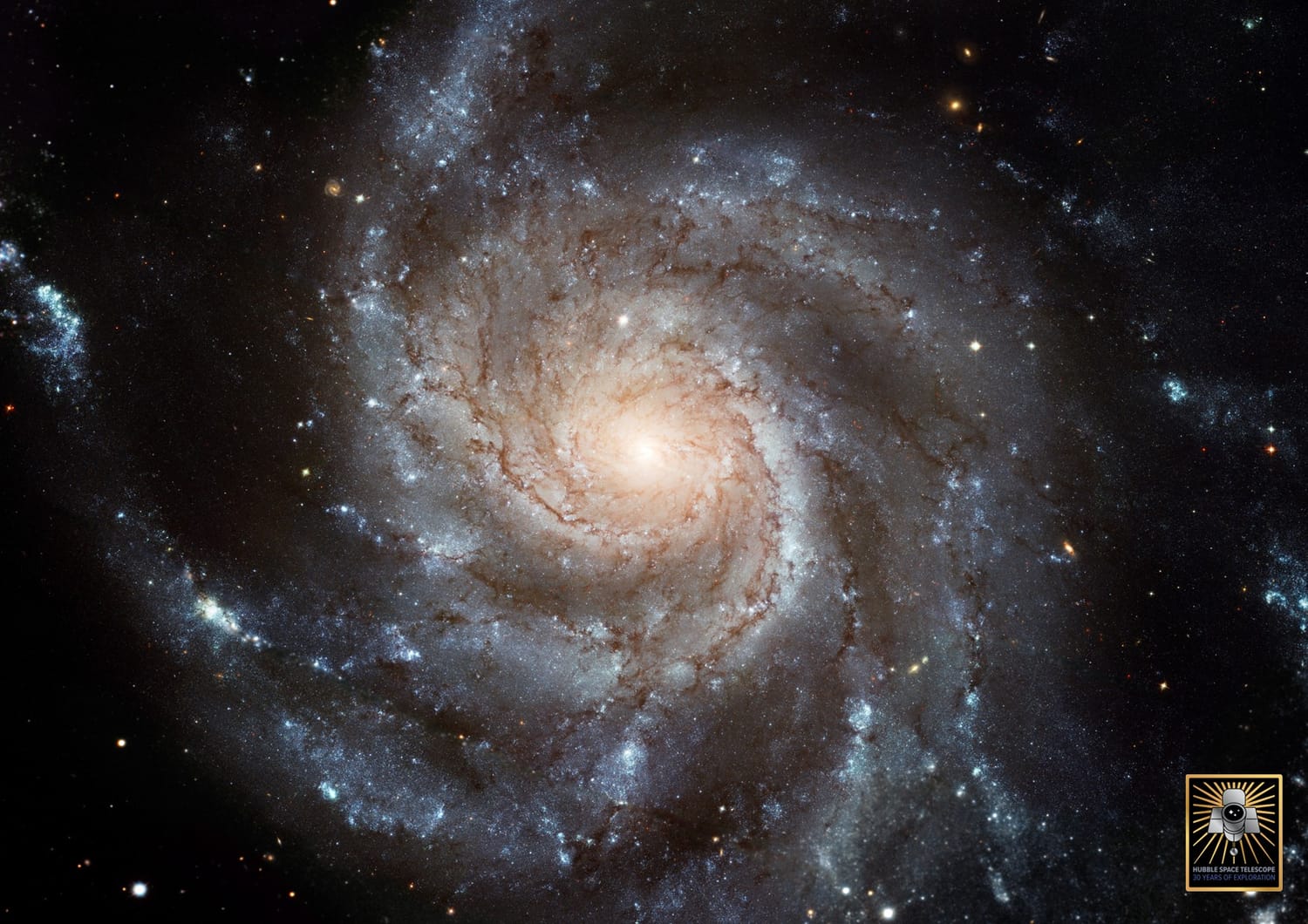
When we look up at the night sky from Earth, most of what we see are stars within our own Milky Way. But beyond that familiar glow lies a vast universe of other galaxies, each with its own unique story. Among these, one stands out because of its beauty, scale, and the insights it offers into how galaxies form and evolve: the Pinwheel Galaxy, officially known as Messier 101 and often abbreviated to M101.
What Is the Pinwheel Galaxy?
The Pinwheel Galaxy is a spiral galaxy located in the constellation Ursa Major, the Great Bear—part of the familiar pattern commonly referred to as the Big Dipper. It lies about 21–25 million light-years from Earth.
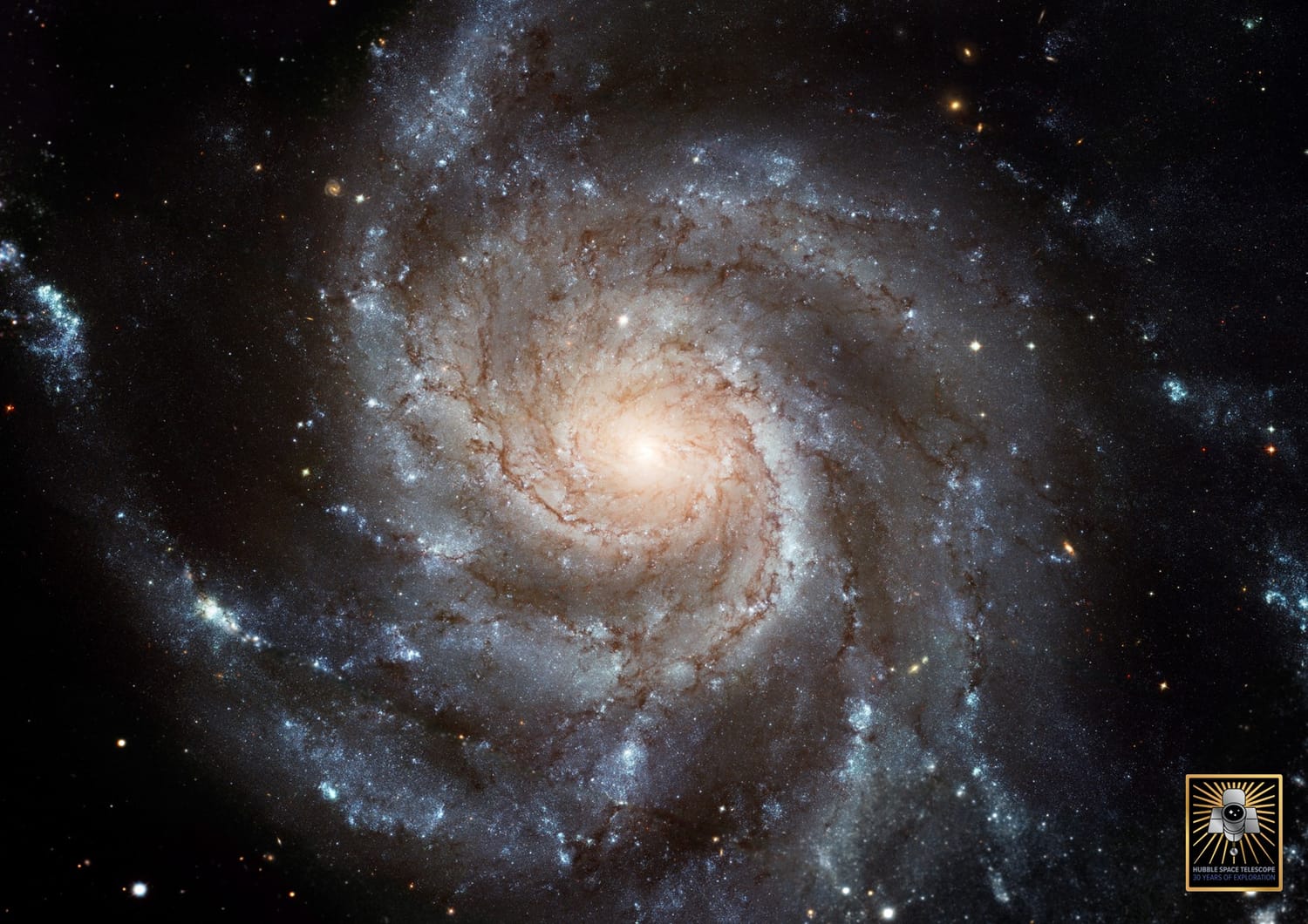
As a “grand-design” spiral galaxy, M101’s form is defined by beautifully sweeping arms that wind outward from a luminous central hub. These arms are studded with bright star clusters and pinkish nebulae, where new stars are being born. The galaxy is oriented face-on from our perspective, allowing telescopes to capture its spiral structure in rich, vivid detail.
In terms of scale, M101 is immense. Its diameter — roughly 170,000–250,000 light-years — makes it significantly larger than our own Milky Way, which spans about 100,000–120,000 light-years. M101 is estimated to contain around one trillion stars, nearly twice the number in our galaxy.
Discovery and Observation
The Pinwheel Galaxy was discovered in 1781 by the French astronomer Pierre Méchain, who reported it to his friend and colleague Charles Messier — famed for cataloging nebulous objects that could be mistaken for comets. Messier later included it as object number 101 in his catalogue of deep-sky objects.
Because it resides high in the northern sky, M101 is a popular target for amateur astronomers. It has an apparent magnitude of about 7.9, meaning that under dark skies it can be seen with binoculars or a small telescope.
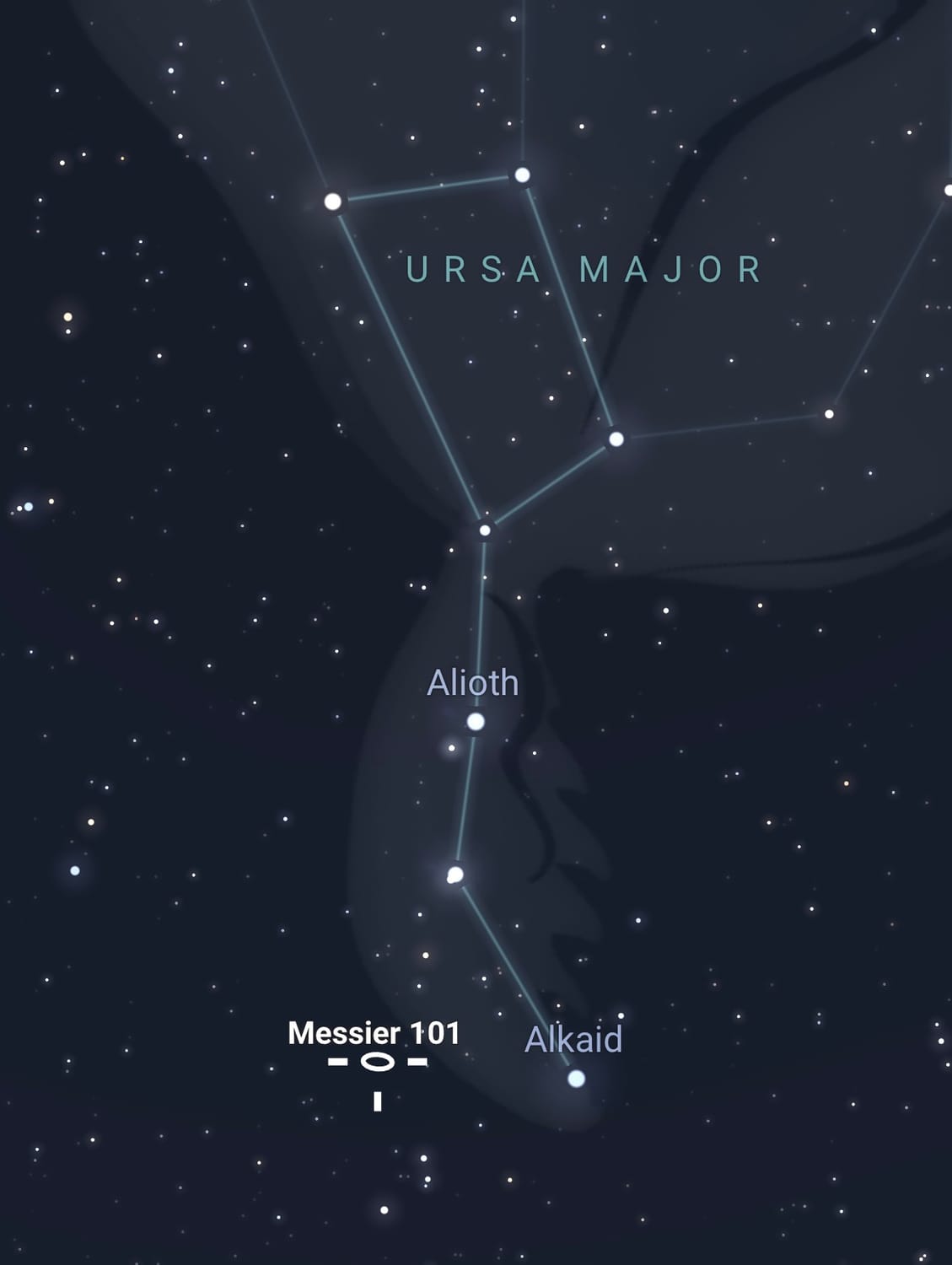
The location of M101 in Ursa Major, produced using Stellarium.
Interesting Aspects
While M101’s spiral beauty alone makes it a favourite subject for astrophotographers and space enthusiasts, astronomers value it for several scientific reasons:
1. A Rich Laboratory of Star Formation
The arms of M101 are brimming with H II regions — vast clouds of ionized hydrogen gas where intense star formation is underway. These glowing regions appear particularly bright in images because they are lit by massive, hot, young stars. In fact, surveys have catalogued thousands of these star-forming regions across the galaxy’s expanse, making M101 one of the most active stellar nurseries in nearby galaxies.
Studying these regions helps astronomers understand how stars form in different environments, how gas and dust flow in spiral arms, and how large galaxies sustain star formation over billions of years.
2. Asymmetry and Galactic Interaction
Unlike many other spiral galaxies that exhibit nearly perfect symmetry, M101’s spiral arms show noticeable asymmetry. This lopsidedness is not merely cosmetic — it suggests that M101 has been influenced by gravitational interactions with smaller companion galaxies. These tidal forces disturb the galaxy’s gas and dust, compressing material in some regions and triggering bursts of star formation.
Understanding these interactions helps astronomers model how galaxies grow and evolve through cosmic time, especially in dense environments where collisions and mergers are common.
3. X-Ray and Multi-Wavelength Insights
M101’s appeal extends beyond visible light. Observations from space telescopes like Chandra (X-ray) and Spitzer (infrared) reveal energetic phenomena that are invisible to the naked eye. X-ray observations, for example, highlight regions with superheated gas, remnants of exploded stars (supernovae), and compact objects like neutron stars or black holes accreting material.
Infrared observations, on the other hand, trace dust structures and cooler materials that often coincide with areas where new stars are forming. When combined across wavelengths — visible, infrared, ultraviolet, and X-ray — these data provide a more complete picture of how galaxies like M101 live and change.
4. Supernovae and Explosive Events
M101 has also hosted several supernovae over the past century. Supernovae are the spectacular explosions marking the deaths of massive stars, and they play crucial roles in dispersing heavy elements throughout galaxies. Observations of supernovae in M101 allow astronomers to study how these events influence their surroundings and contribute to galaxy evolution.
How We See the Pinwheel Galaxy
Viewing M101 is possible even with modest equipment. In dark skies, it appears as a faint, fuzzy patch through binoculars. With a small telescope, its spiral form begins to emerge more clearly. For the best views, astrophotographers use long-exposure techniques to capture hundreds of frames and reveal the galaxy’s complex structure and glowing star-forming regions.
Space telescopes like NASA’s Hubble Space Telescope have captured some of the most iconic images of the Pinwheel Galaxy, showcasing its sweeping spiral arms in incredible detail. These images are not just aesthetically stunning — they are scientifically valuable, revealing the distribution of stars of different ages, dust lanes, and the dynamics of the galaxy’s interstellar medium.
Learn More
Here are some excellent places online to explore the Pinwheel Galaxy further:
NASA’s official page on the Pinwheel Galaxy — offers images and descriptions of multi-wavelength views: https://www.nasa.gov/image-article/pinwheel-galaxy/
NASA Science’s feature on M101 — explains how different telescopes contribute to our understanding: https://science.nasa.gov/asset/webb/infrared-universe-pinwheel-galaxy-m101/
NASA’s “Messier 101” profile — provides context within the famous Messier catalogue: https://science.nasa.gov/mission/hubble/science/explore-the-night-sky/hubble-messier-catalog/messier-101
Wikipedia’s Pinwheel Galaxy page — a comprehensive overview of astronomical data and history: https://en.wikipedia.org/wiki/Pinwheel_Galaxy
Products
Conclusion
The Pinwheel Galaxy (M101) stands as one of the grandest and most studied spiral galaxies visible from Earth. Its sweeping arms, active star-forming regions, dynamic structure, and interactions with companion galaxies make it a key object of interest for both amateur astronomers and professional scientists. Whether admired through a backyard telescope or examined in detail by space observatories, M101 continues to reveal new insights into the workings of our universe.
By exploring galaxies like the Pinwheel, we not only appreciate the sheer beauty of the cosmos but also deepen our understanding of the forces that shape galaxies — including our own.
© AstroPics 2026
AstroPics is a trading name for Sarquol Ltd. Sarquol Limited is registered in England at Sidelands. Long Marton, Appleby-in-Westmorland. CA16 6BT. Company No. 5639332. VAT Reg. No: 872 1344 32.